
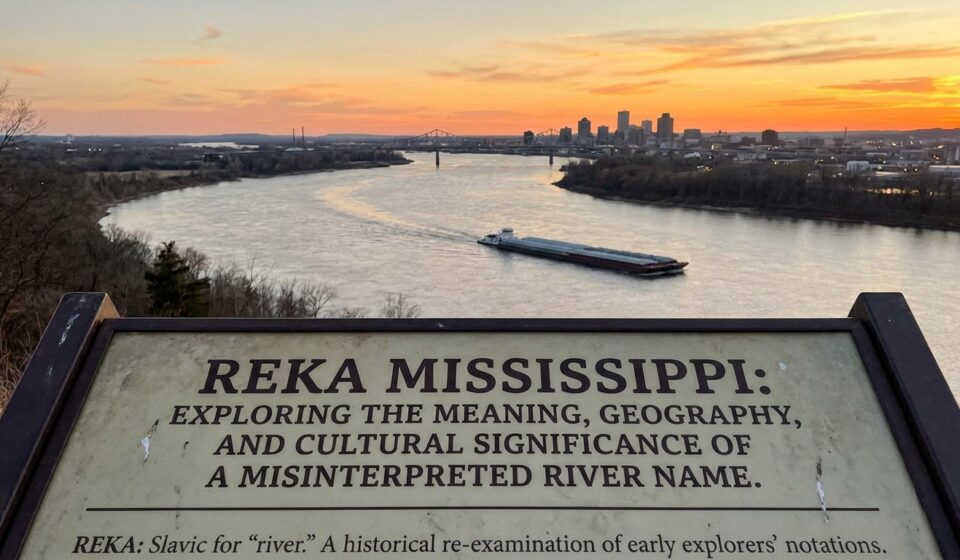

The term “Reka Mississippi” appears to be a blended or misinterpreted phrase that likely refers to the famous Mississippi River, one of the most important and historically significant rivers in North America. The word “Reka” means “river” in several Slavic languages, which suggests that “Reka Mississippi” can be understood as “River Mississippi.”
In this sense, the phrase highlights how language differences and global interpretations can reshape the way geographical names are expressed. The Mississippi River itself is a powerful natural landmark with deep cultural, economic, and historical importance in the United States.
This article explores the meaning behind the term Reka Mississippi, the geography and history of the Mississippi River, and its lasting influence on culture, trade, and environment.
Understanding the Term Reka Mississippi
To understand Reka Mississippi, it is helpful to break the phrase into two parts. “Reka” is a word used in several Slavic languages such as Russian, Polish, Serbian, and others, where it simply means “river.” When combined with “Mississippi,” it becomes a direct reference to the Mississippi River.
This kind of linguistic combination often appears in multilingual discussions, translations, or informal naming conventions. It reflects how global languages adapt geographic names for clarity or explanation.
In English, the correct and widely recognized term is simply the Mississippi River, but “Reka Mississippi” can be seen as a descriptive variation used in non-English contexts.
The Mississippi River: A Geographic Giant
The Mississippi River is one of the longest and most important river systems in the world. It flows through the central United States, stretching from its source in northern Minnesota all the way down to the Gulf of Mexico.
Mississippi River is not only a geographical landmark but also a vital natural resource that has shaped the development of the United States for centuries.
The river passes through or borders several states, including Minnesota, Wisconsin, Iowa, Illinois, Missouri, Kentucky, Tennessee, Arkansas, Mississippi, and Louisiana. Its vast drainage basin covers a significant portion of the country, making it one of the most influential waterways in North America.
Historical Importance of the Mississippi River
The Mississippi River has played a central role in human history long before modern civilization developed in the region. Indigenous peoples lived along its banks for thousands of years, relying on the river for transportation, fishing, agriculture, and trade.
With the arrival of European explorers in the 16th and 17th centuries, the river became a major route for exploration and expansion. French explorers were among the first Europeans to navigate and map the Mississippi River system, recognizing its strategic importance.
During the growth of the United States, the river became a key transportation route for goods and people. It enabled agricultural products such as cotton, corn, and tobacco to be transported efficiently across long distances.
The Mississippi River later became a defining feature in the economic expansion of the United States, especially during the 19th century when riverboats and steamboats dominated trade routes.
Economic Significance of the River System
The Mississippi River remains one of the most important commercial waterways in the world. It supports agriculture, transportation, industry, and energy production across the central United States.
Large cargo ships and barges use the river to transport goods such as grain, coal, petroleum, and manufactured products. This makes it a critical part of the national supply chain and global trade network.
Agricultural regions along the river benefit greatly from its fertile floodplains. The surrounding land is among the most productive farming areas in the United States, contributing significantly to global food supply.
The river also supports industries such as fishing, tourism, and recreation, making it economically valuable beyond transportation alone.
Ecological Importance of the Mississippi River
Beyond its economic role, the Mississippi River is also an essential ecological system. It supports diverse habitats for fish, birds, and wildlife across its extensive basin.
Wetlands, forests, and floodplains along the river provide critical breeding and feeding grounds for many species. These ecosystems help maintain biodiversity and environmental balance in the region.
However, the river also faces environmental challenges, including pollution, habitat loss, and water quality concerns. Agricultural runoff and industrial activity have contributed to ecological stress in certain areas.
Conservation efforts are ongoing to protect the river’s health and ensure that it continues to support both wildlife and human communities.
Cultural Influence of the Mississippi River
The Mississippi River has deeply influenced American culture, literature, music, and identity. It has been featured in countless stories, songs, and historical accounts.
Writers such as Mark Twain famously captured life along the river in classic literature, portraying it as both a symbol of freedom and a force of nature. The river is often associated with adventure, exploration, and the spirit of the American frontier.
In music, especially blues and jazz traditions, the Mississippi River region played a major role in shaping cultural expression. Cities along the river, particularly in the southern United States, became centers of musical innovation and creativity.
The river continues to symbolize movement, change, and cultural diversity in American identity.
Modern Challenges Facing the River
Despite its importance, the Mississippi River faces several modern challenges. Climate change has increased the risk of flooding in certain areas while also affecting water levels and ecosystem stability.
Pollution remains a major concern, particularly from agricultural chemicals and industrial waste. These pollutants can harm aquatic life and reduce water quality for communities that depend on the river.
In addition, infrastructure along the river requires constant maintenance to support transportation and prevent environmental damage. Dams, levees, and navigation systems must be carefully managed to balance human use with ecological preservation.
Efforts by government agencies and environmental organizations continue to focus on protecting the river for future generations.
The Symbolism of Reka Mississippi
When interpreted as “River Mississippi,” the phrase Reka Mississippi also carries symbolic meaning. Rivers have long been used as symbols of life, movement, and transformation in human culture.
The Mississippi River, in particular, represents growth, connection, and natural power. It links distant regions of the United States, acting as a unifying natural feature that supports both economic and cultural exchange.
The idea of “Reka Mississippi” highlights how language can shape perception. It shows how a single natural landmark can be understood differently across linguistic and cultural boundaries.
The Role of the River in American Development
The development of the United States is closely tied to the Mississippi River. Cities along its banks grew into major economic hubs due to their access to transportation and trade routes.
Cities such as New Orleans, St. Louis, Memphis, and Minneapolis owe much of their historical growth to their proximity to the river. These cities became centers of commerce, culture, and industry.
The river also played a significant role in shaping political and territorial expansion in the United States. Control over the Mississippi River was historically seen as strategically important for national unity and economic strength.
Environmental Conservation and the Future
Today, protecting the Mississippi River is a priority for environmental scientists, policymakers, and conservation groups. Efforts are being made to restore wetlands, improve water quality, and reduce pollution levels.
Sustainable management of the river is essential for balancing economic activity with environmental protection. This includes monitoring agricultural practices, improving waste management systems, and preserving natural habitats.
As awareness of environmental issues grows, more initiatives are being developed to ensure that the river remains a healthy and productive ecosystem.
Conclusion
The term Reka Mississippi can be understood as a multilingual interpretation of the Mississippi River, one of the most significant natural waterways in North America. While “Reka” simply means “river” in several Slavic languages, the phrase ultimately points to the vast and influential Mississippi River system.
Mississippi River has played a crucial role in shaping geography, history, economy, and culture across the United States. From its importance in indigenous history to its role in modern trade and environmental systems, the river remains a powerful force in both natural and human development.
As society continues to evolve, the Mississippi River will remain a vital ecological and economic resource, as well as a lasting symbol of connection, movement, and transformation across generations.